
- Home
- PRODUCT CENTER
- ABOUT US
- BLOG
- Application
- FAQ
- CATALOGUE
- Contact Us
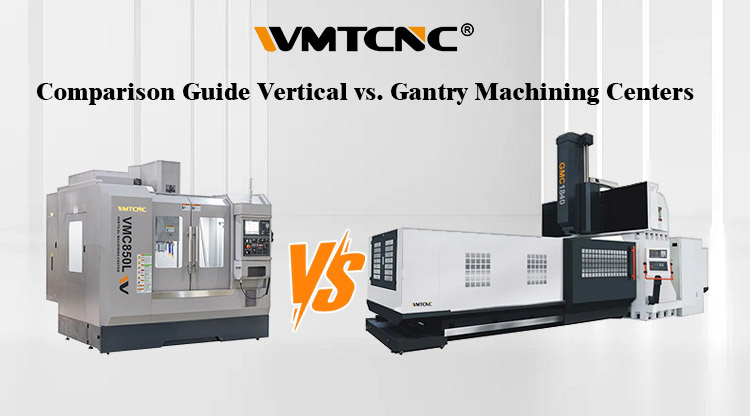
In modern manufacturing, machining centers play a key role in the efficient production of precise and complex components. Among the various types, vertical machining centers (VMCs) and gantry machining centers (GMCs) stand out due to their different designs and applications. Understanding their differences is critical for manufacturers to select the most appropriate equipment for their specific production needs.
Vertical machining centers feature a column-based frame structure with the spindle oriented vertically, perpendicular to the worktable. This design integrates the X and Y axes at the spindle head, with the Z axis moving vertically along the column. The compact and space-efficient layout of VMCs makes them ideal for small- to medium-sized precision parts, such as molds and plate-type components. Typical table sizes range from 1 to 2 meters, with some models extending to approximately 4 meters.
In contrast, gantry machining centers utilize a gantry frame structure consisting of two vertical columns connected by a horizontal beam to form a bridge-like configuration. The Y-axis travels between the columns, and the Z-axis is typically mounted on the horizontal beam. This robust structure provides exceptional rigidity and vibration resistance, allowing large, heavy workpieces to be mounted directly on the worktable. GMCs are well suited for machining large components such as wind turbine parts and machine tool beds, with worktable widths typically exceeding 2 meters and in some cases exceeding 10 meters.

VMCs are adept at machining small to medium complex components, including
– Precision molds: Such as those used for cell phone housings and automotive injection molds.
– Disk-type parts: Including flanges and end caps.
– Small box-type components: Such as sensor housings.
Their design facilitates the consolidation of multiple machining operations such as milling, drilling and tapping, thereby increasing production efficiency.

GMCs are designed for large components, including
– Heavy machinery parts: Such as ship engine bases and mining equipment structures.
– Aerospace components: Including wing frames and rocket fuel tanks.
– Large molds: Such as those for automotive body panels.
Their ability to perform extensive surface milling and deep-hole machining makes them essential for heavy-duty applications.

| Feature | Vertical machining center | Gantry machining center |
| Machining accuracy | ±0.005mm (high-precision models can reach micron level) | ±0.01-0.02mm (more susceptible to thermal deformation) |
| Cutting rigidity | Suitable for light to medium cutting | Capable of heavy cutting (cutting forces can reach several tons) |
| Multi-Axis configuration | Typically configured with 3 axes, optional fourth axis rotary table | Typically configured with 3-5 axes, capable of accommodating large rotary tables |
| Tool capacity | 20–40 tools | 60–120 tools |
| Typical power ratings | 15–30 kW | 30–80 kW (can exceed 100 kW for heavy-duty applications) |
Vertical Machining Centers (VMCs) are ideal for facilities with limited floor space or ceiling height because they have a compact footprint and are typically less than 10 feet tall. This makes them a practical choice for smaller shops or factories in urban or confined environments.
VMCs are particularly well-suited for machining aluminum and other light alloys where high spindle speeds and precise contouring are required. The vertical spindle orientation simplifies tool access and chip evacuation, contributing to improved surface finishes and longer tool life.
In addition, for operations that require frequent product changes or short production runs, VMCs offer faster setup times and easier workpiece clamping. Table accessibility and enclosed design reduce manual handling time and improve operator safety and efficiency.
Typical applications include:
Gantry machining centers (GMCs) are the solution of choice for parts that are exceptionally large in size or weight. When a component exceeds 3 meters in length or weighs more than 5 tons, a GMC is often the only viable option due to its structural robustness and larger work envelope.
In addition, for applications requiring extensive flat surface machining, such as wind turbine hubs or large molds, GMCs provide the necessary stability and cutting force. The bridge design minimizes deflection and provides consistent cutting performance over wide spans.
GMCs are also capable of machining difficult-to-machine materials such as titanium, Inconel or hardened steels, especially in heavy-duty roughing operations. With multi-sided accessibility and compatibility with advanced tool changers and heads, they are preferred in the aerospace, defense and energy sectors.
Typical applications include
Vertical machining centers are developing rapidly, focusing on high-speed machining and function integration. Key trends include
High-speed spindles: Modern VMCs are equipped with spindles that reach speeds in excess of 30,000 rpm, enabling superior surface finishes on aluminum and soft metals.
Multifunction integration: More VMCs now combine turning, grinding or probing capabilities on a single platform-transforming them into multi-process machining centers.
Intelligent Lubrication & Monitoring: Intelligent systems are used to ensure optimal oil delivery to bearings and slides, reducing maintenance and extending machine life.
Thermal Compensation: Real-time compensation for thermal expansion maintains machining accuracy over extended operating cycles.
Compact automation solutions: Robotic arms and pallet changers tailored for VMCs make them more automation-friendly than ever, allowing unattended machining in small-batch production.
Gantry machines are experiencing advances in modular architecture, digital compensation and scalable automation. Key trends include
Modular gantry design: Newer machines are built with modular columns, bridges and rails, allowing for easy customization and transport.
Real-time compensation: Embedded sensors monitor temperature, vibration, and tool wear, and adjust motion commands in real time to maintain accuracy.
Digital Twin Technology: Simulate machining in virtual environments to predict machine behavior under load and avoid collisions.
Multi-Head Flexibility: Gantry systems can be equipped with interchangeable milling heads, turning spindles or additive manufacturing tools to maximize versatility.
Industrial IoT Connectivity: Integration with manufacturing execution systems (MES) and remote diagnostics increases productivity and predictive maintenance capabilities.
In conclusion, both vertical and gantry machining centers play an indispensable role in modern CNC manufacturing. Their different designs, applications and technological strengths make each suitable for different manufacturing needs.
Vertical machining centers are characterized by compactness, precision, and versatility, making them the preferred option for small- to medium-sized parts, quick changeovers, and operations where space is limited. On the other hand, gantry machining centers dominate in large part manufacturing because of their rigidity, large work envelope and ability to handle heavy machining.
The choice between the two ultimately depends on several critical factors:
In many industrial environments, a hybrid approach – integrating both VMCs and GMCs – can provide optimal flexibility to meet nearly the full range of machining needs.
It is important to set up the machining center safely and efficiently. By preparing thoroughly, you will not only improve the performance of the machine, but also protect…… >> Read more
Among the various CNC technologies, vertical machining centers (VMCs) stand out for their versatility, being able to perform milling, drilling, and other operations…… >> Read more
CNC machining supplier can determine the success or failure of your production strategy. Whether you’re sourcing for prototypes or high-volume orders, selecting the right CNC partner ensures product accuracy, optimized cost……>>Read more


Tags: CNC Machining Center
