
- Home
- PRODUCT CENTER
- ABOUT US
- BLOG
- Application
- FAQ
- CATALOGUE
- Contact Us
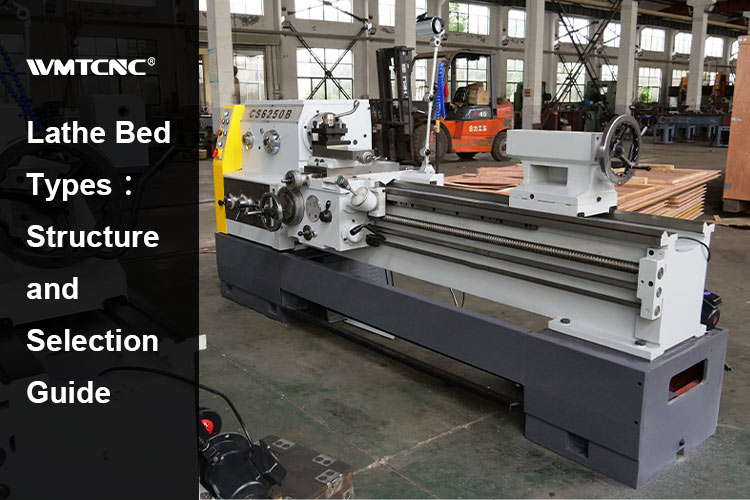
In machine tool construction, the lathe bed serves as the core foundation component. It not only supports the headstock, tailstock, and saddle but also determines the machine’s rigidity, stability, and long-term precision retention. The choice of bed structure directly impacts the lathe’s application range and machining performance.
Many individuals searching for “Lathe Bed Types” confuse the lathe bed itself with the bed ways. In reality, the bed constitutes the integral base structure, while the ways are the guiding surfaces on the bed. This article focuses on the primary types of lathe beds, detailing their structural characteristics and selection criteria.


The lathe bed is typically constructed from high-strength cast iron or welded steel, requiring:
Load-bearing capacity: Supporting critical components like the headstock and tailstock;
Rigidity and stability: Resisting cutting forces and vibrations;
Precision retention: Maintaining straightness and parallelism during prolonged use;
Durability: Minimizing deformation through heat treatment and aging processes.
Thus, the bed serves not only as a physical support but also as a critical safeguard for the machine tool’s precision and longevity.

Structural Features:
Bed parallel to the floor, horizontally arranged as a single unit;
Traditional design with mature manufacturing processes;
Large cross-section for high load-bearing capacity.
Selection Criteria:
When machining large or heavy components, the flat bed provides more stable support;
If budget is limited or a simple, durable structure is required, the flat bed is the preferred choice;
Commonly found in conventional lathes, and also used in some large CNC lathes.

Structural Features:
The bed is inclined relative to the horizontal plane (30°–60°);
Smooth chip evacuation with reduced chip accumulation on guideways;
Enhanced rigidity, suitable for high-speed and automated machining.
Selection Criteria:
Primarily for CNC turning requiring high precision and stability → Slant bed preferred;
Suitable for high-volume production of small to medium-sized parts;
Higher cost than flat bed lathes, but offers superior automation integration and precision retention.

Structural Features:
Features a removable section near the spindle;
Enables expanded turning diameter, accommodating both standard and oversized workpieces.
Selection Criteria:
For workshops handling diverse tasks—processing both standard parts and occasionally large-diameter workpieces—the gap bed offers the most flexible solution;
Commonly found on conventional lathes, it is widely used in maintenance operations and small-to-medium enterprises.

Many readers confuse the bed with the guide rails, but the two are not synonymous:
| Item | Lathe Bed | Bed Ways |
|---|---|---|
| Definition | The overall base structure of a lathe | The guiding surfaces built into the bed |
| Function | Provides rigidity and load-bearing capacity | Guides the carriage and tailstock in precise linear motion |
| Key Factors | Overall stability, load capacity, vibration resistance | Motion accuracy and smooth sliding performance |
| Common Types | Flat bed, slant bed, gap bed | Flat ways, V-ways, dovetail ways, combination ways |
Q1: Are Lathe Bed and Machine Base the same concept?
A1: In most cases, Lathe Bed refers to the machine’s base foundation (Machine Base). However, the lathe bed also serves as a guideway, whereas the base of certain other machine tools may not necessarily include guideways.
Q2: Why are slant beds more common in CNC lathes?
A2: Slant beds offer greater rigidity during high-speed machining and superior chip evacuation efficiency. Their automation compatibility makes them well-suited for CNC production environments.
Q3: Does the “gap” in a Gap Bed Lathe affect rigidity?
A3: If manufacturing and assembly processes are qualified, the gap section can be securely locked. This has minimal impact on routine machining. However, long-term use or low-quality manufacturing may lead to reduced rigidity.
Q4: What materials are typically used for the bed?
A4: Most beds utilize high-strength cast iron (e.g., HT250). Some high-end machines employ resin sand cast iron, welded steel plates, or composite materials to enhance vibration damping and stability.
Q5: Does the lathe bed affect machine tool accuracy?
A5: Yes. The bed’s straightness, parallelism, and resistance to deformation directly determine the alignment accuracy between the spindle and tailstock. It also impacts long-term machining stability.
Q6: Does the bed structure significantly affect machine tool price?
A6: Yes. Horizontal beds are typically the least expensive. Slant beds, being more complex in design and manufacturing, command higher prices. Slant-bed machines fall between the two in cost but offer greater flexibility.
Q7: Can the bed and guideways be replaced separately?
A7: Guideway sections can be regrooved or fitted with wear-resistant plates. However, the bed, being a single cast component, is generally not replaced. If the bed is severely deformed, the machine often loses its repair value.


Tags: Lathe Bed
