
- Home
- PRODUCT CENTER
- ABOUT US
- BLOG
- Application
- FAQ
- CATALOGUE
- Contact Us
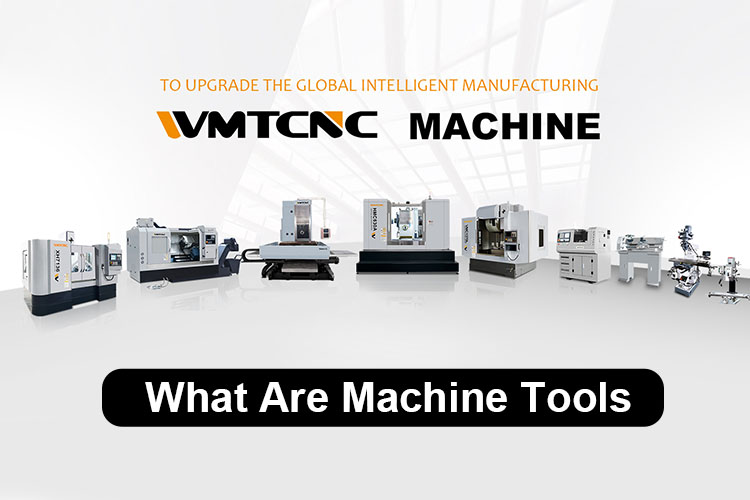
From the engine parts of your car to the casing of your smartphone and the implants used in life-saving surgeries, the work of a category of machines often invisible to the public eye lies behind each of these modern marvels: machine tools. At WMTCNC, we recognise that these tools are the lifeblood of precision engineering, not just equipment. In this article, we’ll explore what machine tools are, how they work, how they have evolved, and why they are indispensable to industries worldwide. If you’ve ever wondered what truly powers the modern manufacturing world, read on.

Machine tools are powered devices used to cut, shape, drill, grind, shear or otherwise deform metal and other rigid materials into precise components. They operate by constraining the motion of the tool and workpiece to controlled paths, removing material in a deliberate and repeatable manner. Unlike simple hand tools, machine tools function with exceptional precision and rigidity, often achieving tolerances of ±0.01 mm or tighter.
Rightfully referred to as the ‘mother machines’, they manufacture other machines, tools, moulds, dies and critical components across sectors. Think of them as the skilled artisans of the industrial world, but powered by motors, computers and software.
High Rigidity: The structural frames must be able to withstand intense forces without becoming deformed.
Precision: It is capable of achieving microscopic accuracy and repeatability.
Power-Driven: It is operated via electricity, hydraulics or pneumatic power.
Programmability: Modern machine tools often feature CNC (computer numerical control) systems, which allow highly automated, multi-step machining with minimal human intervention.

At their core, machine tools transform raw materials into parts that have a specific geometry, finish and functionality. This is primarily achieved through subtractive processes, whereby excess material is removed to reveal the final form.
This involves removing material via cutting, turning, milling or grinding.
Creating features such as holes, threads, slots and grooves.
Achieving surface finishes ranging from industrial grade to a mirror-like polish.
We ensure consistent part dimensions within extremely tight tolerances.
Speed and efficiency: Enables rapid mass production.
Precision and consistency: Delivers identical parts, batch after batch.
Complex geometry handling: Creates features that would be impossible to achieve by hand.
Material versatility: Works with metals (steel, aluminium, titanium), plastics, composites and more.
Foundation for automation: CNC machines are a vital component of smart factories and Industry 4.0.

Machine tools are categorised according to how they manipulate the workpiece and the type of material removal or deformation involved.
Lathe: A machine that rotates the workpiece while a stationary tool performs turning, facing and threading operations.
Milling machine: A rotating tool removes material by traversing across a fixed workpiece.
Drill press: Specialises in making precise round holes.
Grinding machine: Uses abrasive wheels to achieve ultra-smooth surface finishes and fine tolerances.
A CNC machining centre is a multi-function tool capable of milling, drilling, boring, and tapping, often with automatic tool changers. A multifunctional tool capable of milling, drilling, boring and tapping, often with an automatic tool changer.
Press brakes and stamping presses: Deform sheet metal into the desired shape.
Shears and folding machines: Cut and bend flat stock efficiently.
EDM (Electrical Discharge Machining): Sculpts hard metals using electrical sparks.
Laser/plasma cutters and water jets: Use focused energy or water pressure to cut without mechanical force.
Additive machines (3D printers): Build parts layer by layer to complement subtractive tools in prototyping and speciality applications.

Machine tools operate through a combination of structured elements, including the workpiece, the tool, a motion system (either CNC or manual), a power drive and a control interface. CNC machines use G-code generated by CAD/CAM software to carry out complex, high-precision tasks independently.
Workpiece: The raw material, such as a metal bar, sheet or billet.
Tool: The cutting or shaping element, such as a drill bit or milling cutter.
Motion system: The tool, the workpiece, or both are moved along the X, Y and Z axes (and more).
Power drive: Electric motors or hydraulic systems.
Control system: Manual, semi-automatic or fully CNC-programmed for precision.
CAD software is used to generate part geometry.
CAM software then converts this geometry into G-code.
The operator then loads the workpiece and initiates the program.
The machine then carries out the operations automatically.
Quality control ensures that the part meets the required dimensions.

Machine tools have come a long way.
Ancient times: Egyptian bow lathes around 3000 BC.
18th century: Steam-powered tools fuelled mass production.
19th century: Electrification enabled the production of compact, powerful machines.
1960s onwards: CNC automation redefined accuracy and scalability.
Today: AI- and IoT-enhanced machine tools offer remote monitoring, predictive maintenance and real-time analytics.
To stay at the forefront of this evolution as a manufacturer is to ensure your competitiveness — and we at WMTCNC are committed to doing just that.

The following comparative table outlines the key differences: Although CNC offers superior precision, repeatability, flexibility and automation, it comes at a higher initial cost and is more complex.
| Feature | Traditional Machine Tool | CNC Machine Tool |
|---|---|---|
| Operation | Manual/handwheel | Fully computerized |
| Precision | ±0.05 mm – ±0.1 mm | ±0.002 mm – ±0.01 mm |
| Setup Time | Short | Longer (offset by fast runtime) |
| Repeatability | Operator-dependent | Highly consistent |
| Flexibility | Limited | Capable of complex geometries |
| Tool Changing | Manual | Automatic |
| Cost | Lower initial investment | Higher upfront, lower per-part |
Machine tools are an integral part of every major industry. Their precision and adaptability make them invaluable for a wide range of applications.
Automotive: Engine blocks, axles, gears and suspensions.
Aerospace: Lightweight, precision parts, such as turbine blades and landing gear.
Medical devices:
– Surgical implants
– Orthopaedic tools
– Dental components
Electronics: Circuit board enclosures, connectors and injection plastic moulds.
Energy: Wind turbine components and gas compressor parts.
Consumer goods: Everything from door handles to kitchenware begins life as a machine tool product.
At WMTCNC, we have the machining capabilities to produce critical components for clients in these sectors, backed by years of know-how and investment in advanced CNC and precision grinding systems.

The selection of a suitable machine tool depends on:
Material type: Soft aluminium? Hard steel? Composites?
Part geometry and size: Do you need 5-axis capability? Long workpieces?
Production volume: High mix, low volume vs. mass production.
Tolerance requirements: Do you need ±0.005 mm accuracy?
Operator skill and workflow integration: CNC or hybrid?
Budget: Consider long-term ROI, not just the purchase price.
Would you like some tailored advice? Contact our engineering team for professional recommendations based on your unique requirements.
Machine tools are the unsung heroes of the industrial age. They transform designs into reality, providing the precision and scalability required by modern manufacturing. As a machine tool manufacturer and machining service provider, WMTCNC does more than just use these tools — we master them. Whether we’re working on a single prototype or a high-volume production run, our team ensures that each component meets the strictest standards of precision, quality and reliability.
Let’s build the future — one micron at a time.


Tags: What are Machine Tools
