
- Home
- PRODUCT CENTER
- ABOUT US
- BLOG
- Application
- FAQ
- CATALOGUE
- Contact Us
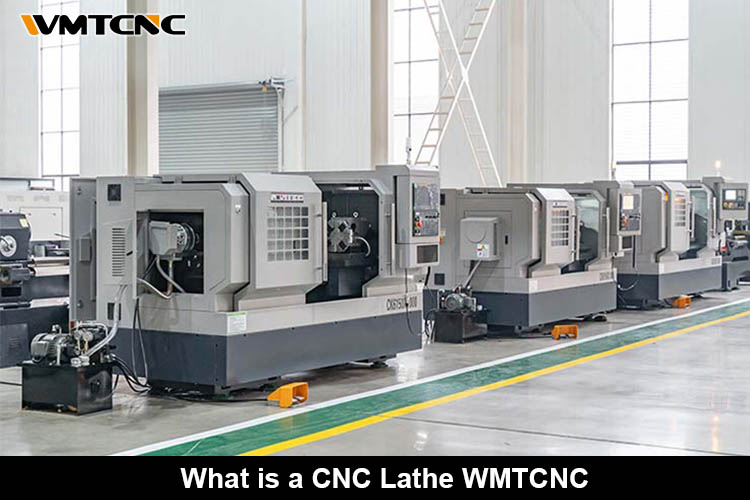
A CNC (Computer Numerical Control) lathe is a precision machine tool that rotates a workpiece on a spindle and uses cutting tools and drill bits of various diameters to remove excess material. It combines the traditional turning method of producing symmetrical shapes through rotation with computerised control via G-code and M-code instructions. By automating turning operations, CNC lathes can achieve consistent micron-level accuracy, enabling the efficient production of complex geometries with minimal human intervention. These machines can produce a wide variety of shapes, cuts and details on rotating parts, even those made of tough materials, and they are available in vertical and horizontal configurations. In this article, we will explore the differences between the two types and their respective applications.

Delving into the workings of a CNC lathe reveals a symphony of precision engineering and computerised control. Unlike manual lathes, which rely heavily on the skill of the operator, CNC lathes follow a defined, software-driven process that improves repeatability, accuracy and production speed.
At the heart of a CNC lathe are mechanical components such as the bed, spindle, tool turret and servo-driven axes, which are coordinated by a CNC controller that acts as the machine’s “brain”.

A CNC lathe consists of carefully engineered components that work together to achieve precise turning.
– Main Spindle: This rotates the workpiece and is driven by a motor.
– Chuck : It secures the workpiece during rotation.
– Tailstock: Provides rear support, especially for long or thin parts.
– Tool Turret: Holds multiple tools and indexes as required by the programme.
– Control Panel (CNC Controller): Inputs, displays and executes G-code instructions.
– Bed: A rigid foundation that supports all mechanical movement.
– Carriage: Slides along the bed and carries the tool.
– Headstock: Houses the spindle motor and speed controls.
– Coolant System: Cools the tool and workpiece to prevent overheating.
– Chip Conveyor: Removes metal chips to keep the work area clean.

CNC lathes offer remarkable versatility across industries thanks to their ability to perform multiple operations with great precision.
– Turning: removing material to form cylindrical shapes
– Facing: creating flat surfaces on ends or shoulders
– Drilling, boring and reaming: creating or refining internal holes.
– Threading: generating screw threads (internal/external).
– Knurling: adding textured patterns for grip
– Grooving/parting: cutting functional grooves or separating parts.
– Chamfering: creating angled edges or bevels
– Eccentric turning: machining off-centre profiles
– Tapping: forming internal threads using taps.
– CNC milling (with live tooling): adding slots, holes or side features to lathes with Y/C-axis capability.

The effectiveness of CNC lathes hinges heavily on the supporting software ecosystem that facilitates the entire process.
– CAD software: Examples include AutoCAD, SolidWorks and Fusion 360.
– CAM software: Mastercam, GibbsCAM and Fusion 360.
– G-code editors: NC Corrector and G-Wizard Editor.
– CNC simulation tools: VERICUT and NC Viewer.
– Toolpath optimisation: Built into most CAM packages.
– DNC software: Predator DNC and CIMCO DNC for machine communication.
– Monitoring systems: MDC-Max and FactoryWiz for performance tracking.
– Post-processing tools: Convert CAM output to machine-specific code.
– Integrated CAD/CAM suites: Fusion 360 and BobCAD-CAM.
– 3D modelling: Rhino and Blender (for complex or artistic forms).
– Quality control software: PC-DMIS and Quality Control Systems.
– Custom CNC control: LinuxCNC and Mach3/4 for specialised setups.

CNC horizontal lathe machining uses horizontally configured lathes. These machines rotate the workpiece cylindrically, like a rotisserie chicken, while the tooling cuts away excess material to shape the piece. As the workpieces must lie vertically, horizontal lathes tend to have a larger footprint, meaning they are best suited to smaller or medium-sized workpieces. Similarly, since the chuck on these machines holds the workpiece vertically against gravity, these machines are best used for lighter materials; otherwise, you risk damaging the chuck. If you are buying a used CNC lathe machine, it is particularly important to keep this information in mind and be sure to ask your dealer about the machine’s past work history.
In a CNC vertical lathe, the workpiece rotates upright, similar to a pottery wheel. This allows the spindle to cut at hard-to-reach angles. This gives vertical lathes a smaller footprint than horizontal lathes naturally, making them ideal for manufacturing extremely large and heavy workpieces, including those that have to be loaded with a crane. The smaller footprint also allows dual spindles to work on a piece without compromising additional floor space, making them a good choice for pinch turning operations. Additionally, the machine’s vertical design means that gravity keeps the workpiece stable throughout the machining process, allowing for steady spindle movements and more accurate cutting. However, it is important to note that vertical lathes tend to be more expensive than their horizontal counterparts.

| CNC Lathe Type | Axis Configuration | Key Features | Best Use Case |
|---|---|---|---|
| 2-Axis Horizontal | X & Z | Basic turning, cost-effective | Simple cylindrical parts |
| 3-Axis Live Tooling | X, Z, with Y* | Adds milling capability | Mid-complex parts requiring drilling or milling |
| 4–6‑Axis / Mill‑Turn | X, Z, C, Y/A/B | Multi-process, single setup machines | Precision aerospace/medical components |
| Swiss-Type | X, Z (+ guide bushing) | High rigidity, micro-precision | Long, slender precision parts (e.g., implants) |
| Vertical (VTL) | X, Z, vertical workpiece | Gravity-assisted, large workpieces | Heavy or wide disk/plate components |
| Slant vs. Flat Bed | Horizontal | Chip control vs. workspace size | High-efficiency vs. large-part scenarios |
* Y-axis often achieved via live-tooling.
CNC lathes support high-precision parts across virtually every major industry:
Common materials include carbon steel, stainless steel, aluminium, brass, titanium, high-performance polymers and composites.

CNC lathes lie at the heart of scalable, high-precision manufacturing. Their automation, accuracy and versatility make them indispensable for everything from basic shafts to life-saving medical parts.
At WMTCNC, we do more than just supply machines. As a manufacturer deeply rooted in the machining industry, we help clients select, customise and optimise CNC solutions tailored to their production goals, whether for prototyping or 24/7 automated high-volume output.
Let’s work together to build the future of precision manufacturing.


Tags: What is a CNC Lathe
