
- Home
- PRODUCT CENTER
- ABOUT US
- BLOG
- Application
- FAQ
- CATALOGUE
- Contact Us
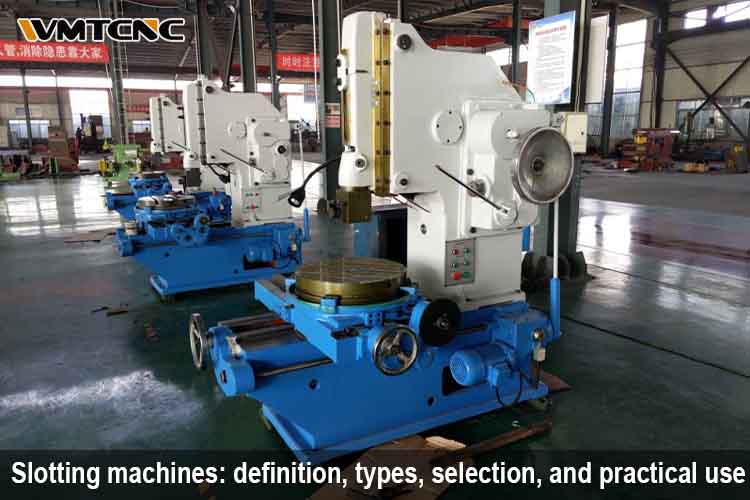
A slotting machine (also called a vertical shaper) is a reciprocating machine tool used to create internal keyways, splines, grooves, and slots, and to shape internal and external profiles. The defining characteristic is vertical tool motion: a ram drives a single-point cutting tool up and down while the work is clamped on a table that can be advanced longitudinally, crosswise, and often rotationally. On the down-stroke the tool cuts; the return stroke is non-cutting and minimized via stroke adjustment.
The ram’s motion is produced either by a hydraulic system (smooth, adjustable) or a mechanical variable-speed motor and gear train (robust, simple). With a leveled base and aligned column, the ram rides accurate guideways so the tool remains square to the work. Slotters are ideal for single pieces or small batches, while heavy production versions exist for repetitive parts.
Slotters excel whenever a vertical tool approach is advantageous: blind internal features, internal flats, irregular internal profiles, and even internal/external gear work with appropriate indexing. Compared with a shaper (horizontal ram), the slotter’s vertical action simplifies many internal features; compared with milling, a slotter can machine non-circular internal openings—hexagon sockets, internal oil grooves, ratchet forms—without broaches or special form cutters.

The base is a rigid casting shouldering cutting loads and supporting the whole machine; its top is precision-finished with guideways that locate the saddle. The column—a vertical casting tied to the base—houses the ram drive and often the feed mechanisms. On the front face of the column, precision vertical guideways carry the ram.
The work table may be fixed or rotary. A rotary table adds circular feed, angular indexing, and complex internal profiles; degree graduations and power rotation are common in advanced models.
The ram holds a tool head for a single-point cutting tool (HSS or carbide). Stroke length and position are adjustable—via crank/gear linkages or hydraulic trip dogs—so you can match the stroke to job height and minimize non-cutting travel. Correct ram-to-body alignment is crucial for holding keyway width and wall squareness.
Slotters provide longitudinal, cross, and often rotary feeds. Feeds can be manual or power-driven, with intermittent indexing timed to each cutting stroke for efficiency.

Hydraulic slotters use a pump feeding a cylinder; pilot valves and travel dogs reverse flow at stroke ends. Advantages include smooth, controllable velocity, easy stroke adjustment, and useful damping on the cutting stroke. Maintenance centers on oil cleanliness, seal condition, and temperature.
Mechanical slotters use a motor and gear train to transform rotation into reciprocation. They are rugged and straightforward to maintain, favored for heavy production or environments where hydraulic service is challenging. Modern designs add multiple speeds and flywheels to smooth the cutting impulse.
Two first-order capacity numbers:
Job diameter (A): Max diameter that can be clamped/swept under the ram without column interference.
Stroke length (B): Max vertical travel of the ram—practically your maximum job height in a single setup. Adjustable stroke is essential to reduce idle time.
Check motor power (kW), number of speeds, and feed ranges for longitudinal, cross, and rotary motions. Confirm table diameter, T-slots, clamping options, and degree graduations for indexing. Ensure three-phase AC compatibility and assess floor space and guarding.
Look for high-grade cast iron, documented ram-to-body alignment, helical gears, gun-metal bushings, and proper lubrication (oil cups or centralized). These factors drive accuracy, finish, and uptime.

Map your parts portfolio to machine types:
Rigid fixturing—with proper clamps and T-slot hardware—prevents vibration and “slot taper.” Use guards and interlocks, and validate trip-dog settings before the first dry run. Your first-article protocol should confirm slot width, position, perpendicularity, and surface finish; record stroke, feed, and tool geometry so results are repeatable.
Slotters are often lower-cost to purchase/maintain than broaching or some milling solutions, with the trade-off of a non-cutting return stroke. Over time, you can upgrade with a power rotary table, DRO, and improved fixturing to expand part families and throughput.

Internal keyways, splines, internal/external grooves, non-circular internal holes (e.g., hex sockets), internal flats, ratchet and gear-ring features with indexing, and recesses on concave/convex internal surfaces. Used across power plants, steel mills, shipbuilding, textile, repair shops, and tool rooms.
| Feature / Use Case | Slotting Machine (Vertical Shaper) | Shaper (Horizontal Ram) |
| Tool Motion | Vertical reciprocating | Horizontal reciprocating |
| Best For | Internal keyways, splines, grooves, internal flats, irregular internal profiles | External flats, steps, general planar work |
| Stroke Control | Adjustable (trip dogs / hydraulics) | Adjustable (crank/gear) |
| Rotary/Indexing | Common with rotary tables | Less common |
| Setup Complexity | Moderate; fixturing critical | Moderate |
| Throughput | Good for small batches/repair | Good for small batches |
| Typical Limitations | Non-cutting return stroke; needs skilled setup | Similar; horizontal approach limits internal features |

Slotting machines remain indispensable where vertical tool approach and internal geometry dominate. Select the type (puncher/toolroom/production) to match your part family, prioritize A (job diameter) and B (stroke length), and invest in alignment, lubrication, and fixturing. With disciplined maintenance and stroke optimization, a slotter delivers accurate, economical results for years. As needs grow, rotary tables, DROs, and refined SOPs expand capability and throughput—without changing the core machine.
BT tapers (BT30/40/50) offer symmetric design for high rigidity and compatibility with autocheckers; SK tapers follow DIN 69871, excel in concentricity and high-speed stability—choose based on machining needs and regional support.>> Read more
Shaper machines utilize a reciprocating single-point cutter to shape flat surfaces, grooves, and profiles. Available in crank, hydraulic, vertical, universal, and traveling-head types, they excel in heavy-duty, precise, short-run tasks and are increasingly adapted with CNC retrofits.>> Read more
DC motors offer precise speed and high starting torque for robotics and EVs but need maintenance. AC motors are rugged, low-cost, with long lifespan—ideal for HVAC, industrial machinery, and appliances.>> Read more
CNC automation leverages digital control to streamline machining for precision, speed, and cost-efficiency. By replacing manual input with CAD/CAM-driven G-code, modern CNC systems drive consistent, high-volume production.>> Read more
CNC spindles are vital for machining functions like drilling, milling, and cutting, with diverse structural designs tailored for precision and application-specific performance.>> Read more


Tags: Slotting Machine
