
- Home
- PRODUCT CENTER
- ABOUT US
- BLOG
- Application
- FAQ
- CATALOGUE
- Contact Us
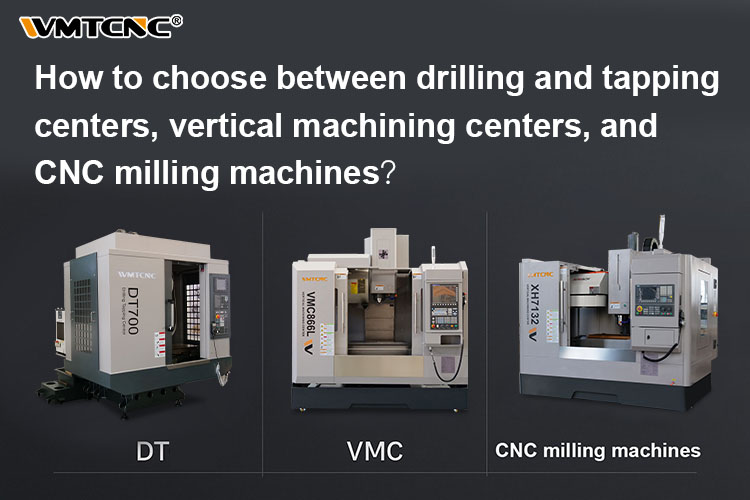
Drilling & Tapping Machine Center (DTC): Choose when most of your cycle time is hole-making and you need maximum throughput with ultra-fast tool changes and high rapids. Best on moderate-hardness materials (aluminum, plastics, light steels, typically up to ~45 HRC). Milling is light only.
Vertical Machining Center (VMC): Your general-purpose all-rounder for milling + drilling + tapping on complex parts and tougher materials (with proper tooling, finishing near ~60 HRC is feasible). Emphasizes rigidity, versatility, and tool capacity.
CNC Milling Machine (general): The umbrella category that includes both vertical and horizontal milling platforms (and 5-axis variants). If you need multi-directional cutting, horizontal spindles, or 5-axis flexibility, you’re looking beyond a basic VMC into broader CNC milling.
Bottom line: If holes dominate and takt time rules → DTC. If milling complexity and rigidity dominate → VMC (or a broader CNC mill where horizontal/5-axis is relevant). Many shops win by combining both (hybrid cells).

A DTC is a compact, speed-optimized CNC platform tailored for rapid drilling and tapping with light milling capability. Expect high-speed spindles (often 15,000–20,000 RPM), sub-second tool changes, and excellent rapids/acceleration that slash non-cut time. Frames are lighter and spindles lower-horsepower than VMCs; the trade-off is deliberate: velocity over brute force. Ideal for mass production of parts with many small/medium holes where repeatability and throughput are king.

A VMC is a vertical-spindle CNC milling machine built as an all-rounder. It handles milling, drilling, tapping, and 3D contouring on a stationary table (X–Y) with the spindle moving in Z. VMCs feature stiff structures, higher spindle horsepower, and tool magazines commonly holding 20+ tools. That combination enables heavy material removal, complex geometries, and long unattended cycles. With correct tooling/strategies, VMCs can work confidently on harder alloys compared with DTCs.

“CNC milling machine” is the broader family, covering vertical (VMC), horizontal (HMC), and 5-axis platforms. If your work needs side milling advantages (chips evacuate with gravity; better for deep pockets in some cases), horizontal spindles help. If you require multi-axis surfaces or single-setup complexity, 5-axis enters the conversation. A VMC is thus a subset of CNC milling; DTCs are specialized CNCs optimized for hole-making speed.

DTC: Lower HP, lighter frames. Wonderful for drilling/tapping at speed, but not the tool for wide step-overs, deep slotting, or aggressive side-milling in tough alloys.
VMC: Higher HP, robust frames. Handles heavy cuts and complex milling with more confidence, including harder materials when needed.
CNC Milling (broader): Adds options like HMC (great chip evacuation, productivity in certain families) or 5-axis (single-setup parts and complex surfacing).
DTC: Ultra-fast rapids and sub-second ATC translate into real-world cycle-time savings on hole-dominant programs.
VMC: Still quick, but ATCs are usually 2–7 s chip-to-chip; designs favor stability under heavier load.
CNC Milling (broader): Performance varies—premium HMC/5-axis centers can be very fast but usually target rigidity + geometric capability.
Exceptional speed for drilling/tapping; rapids + sub-second ATC crush non-cut time.
Compact footprint enables high machine density.
Energy-efficient for hole-dominant tasks.
Excellent repeatability for threaded holes; predictable throughput.
Lower cost per part in hole-heavy production.
Limited milling; not intended for aggressive cuts, deep pockets, or wide step-overs in tough alloys.
Smaller work envelope than many VMCs.
Less versatile; complex 3D work likely reroutes to VMC/HMC/5-axis.
Vertical Machining Center (VMC)
Versatile across milling, drilling, tapping; handles complex geometries.
Rigid & powerful, enabling heavy material removal and harder alloys.
Tool capacity (20+ tools common) supports long, multi-op sequences.
Scalable from compact to very large travels.
Slower for hole-heavy programs than a DTC (tool-change and rapids limitations).
Larger footprint per work envelope.
Potentially higher energy use for very light work.
Choice of architectures (vertical, horizontal, 5-axis) to match part families.
Multi-directional cutting, better chip evacuation in some orientations.
Single-setup complexity with 5-axis.
Higher capital and integration complexity as you move to HMC/5-axis.
Programming/fixturing sophistication required for multi-axis productivity.

Consumer electronics: thin plates/chassis with many threaded holes.
Automotive components (volume): small housings and brackets with repetitive holes.
Medical disposables/instruments (volume): many small holes with tight repeatability.
Pneumatics/hydraulics manifolds: dense hole patterns and threads.
Fastener/connector families: rapid tapping and drilling.
Aerospace & defense: structural brackets, stiffer toolpaths, occasional harder alloys.
Mold & die: 3D surfaces, blends, and finishing in tool steels.
Automotive prototyping/specialty: complex geometries, numerous operations.
Job shops: unknown mix—VMC handles surprises gracefully.
HMC: Efficient side-milling, gravity-assisted chip evacuation, palletization for uptime.
5-Axis: Complex surfaces, one-setup machining, aerospace blisks, orthopedic geometries.

DTC: Standardize drills/taps/countersinks; stock redundancies; balance small tools at high RPM.
VMC: Use high-clamp-force holders for heavy roughing; consider shrink-fit/hydraulic for finishing; balance for high-RPM finishing on hard materials.
DTC: Validate thread quality and positional repeatability at speed; ensure reliable chip evacuation.
VMC/CNC Mill: Track runout, dynamic stiffness, and thermal behavior on long cycles or hard materials.
Daily: Clear chips; verify coolant/air; listen for spindle anomalies; check tool clamp integrity.
Weekly: Lubricate rails/ballscrews; inspect ATC grippers/arms; verify backlash and offsets.
Monthly: Run geometry checks (straightness, squareness), spindle runout, electrical connections, and safety interlocks. Keep a simple maintenance log—it catches drift early and prevents surprises.
DTC: ATC mis-picks due to chip contamination or inconsistent tool lengths.
VMC: Thermal drift on long heavy cycles; taper/pull-stud contamination hurting repeatability.
CNC mills (broader): Under-spec’d fixturing for multi-axis loads; insufficient chip control in horizontals.

Choose DTC when repetitive drilling/tapping dominates and takt time rules.
Choose VMC when milling complexity, rigidity, and harder materials drive outcomes and CNC milling (HMC/5-axis) when multi-directional cutting or single-setup complexity is essential.
Many shops thrive with a hybrid strategy: a VMC to absorb heavy milling and a DTC (or two) to drain the hole queue. Anchor your decision in part mix, hardness, envelope, and throughput math, then back it with disciplined maintenance.
Choosing the right CNC machining supplier is crucial for successful production. Consider factors like technical capability, pricing, quality certifications, communication, and customer support. Evaluate their experience, equipment, and reliability to ensure high-quality, timely production.>> Read more
Vertical machining centers (VMCs) are ideal for small to medium-sized, high-precision parts with limited space. Gantry machining centers (GMCs) excel in large, heavy-duty applications requiring high rigidity and extensive surface milling. The choice depends on workpiece size, precision, and space.>> Read more
CNC automation leverages digital control to streamline machining for precision, speed, and cost-efficiency. By replacing manual input with CAD/CAM-driven G-code, modern CNC systems drive consistent, high-volume production.>> Read more
DC motors offer precise speed and high starting torque for robotics and EVs but need maintenance. AC motors are rugged, low-cost, with long lifespan—ideal for HVAC, industrial machinery, and appliances.>> Read more
Shaper machines utilize a reciprocating single-point cutter to shape flat surfaces, grooves, and profiles. Available in crank, hydraulic, vertical, universal, and traveling-head types, they excel in heavy-duty, precise, short-run tasks and are increasingly adapted with CNC retrofits.>> Read more


Tags: CNC Machining Center, CNC Milling Machine, Drilling and Tapping Machine
